









PROPERTY SEARCH

Warning over migrant healthcare cuts as Andalucía faces political pressure
Public health experts say limiting care for undocumented migrants would cost more and create wider risks for society
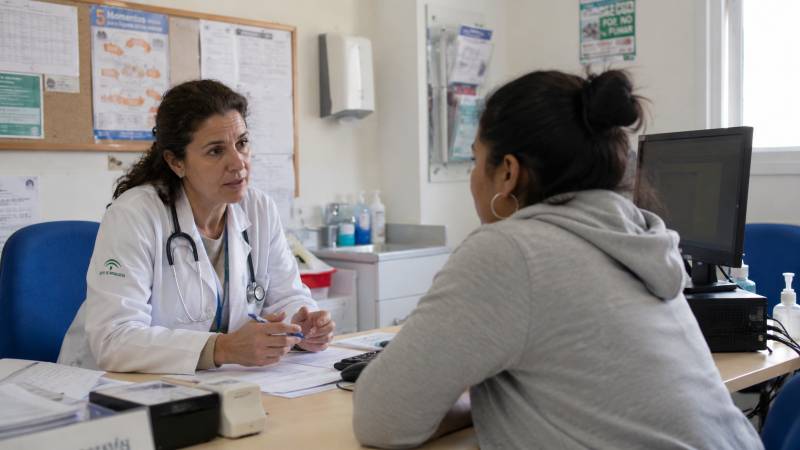 A leading Spanish public health expert has warned that restricting healthcare access for undocumented migrants in Andalucía would be “unethical”, “counterproductive” and ultimately more expensive for the public system.
The debate has resurfaced following the Andalusian elections on Saturday May 17, with Juanma Moreno potentially needing support from Vox to form a government. The party has already said it wants to push forward its policy of “national priority”, including limits on access to public services for people without legal residency.
The discussion comes only weeks after Spain approved new measures reinforcing universal healthcare rights for foreigners without legal residency, ahead of plans to regularise around half a million migrants.
Similar agreements have already appeared in Extremadura and Aragón, where proposals include restricting undocumented migrants to emergency healthcare only.
But Eduardo Satué, outgoing president of the Spanish Society of Public Health (SESPAS), warned that removing access to routine healthcare would create serious problems for both patients and the wider population.
“It is neither ethical nor efficient,” he said. “Not treating a patient does not eliminate the problem, it worsens it.”
He argued that excluding migrants from primary healthcare would simply increase pressure on emergency departments, where treatment costs are significantly higher. “Just one night in hospital costs more than any treatment that could be provided through primary care,” he explained.
To underline the point, Satué gave the example of a diabetic patient left without treatment. “They would develop serious kidney and eye problems and eventually need urgent hospital treatment. That costs far more than giving them a metformin pill that costs €2.”
Andalucía currently has the largest public healthcare system in Spain, serving nearly eight million people. Around 700,000 foreign nationals are registered within the system, representing approximately 8.7% of the population. According to figures from the Junta de Andalucía, undocumented migrants account for only around 1% of total healthcare demand.
Satué also rejected the idea that migration is behind the strain on the healthcare system, arguing instead that Spain’s ageing population remains the main long-term challenge. “Those who come are usually young and healthy,” he said, noting that older residents are more likely to require ongoing and complex medical care.
Reports from the Andalusian Health Service also suggest migrants use healthcare services less frequently than Spanish-born residents. Emergency hospital visits among migrants stand at 17%, compared with 21% among Spaniards, while fewer migrants attend specialist appointments or receive preventative care such as flu vaccinations.
The public health expert also warned about wider collective risks linked to infectious diseases if people are denied access to healthcare. “It is counterproductive to what we seek in societies, which is a better quality of life,” he said.
The political row also comes at a time when Spain has seen a sharp increase in racist and hate-filled social media posts linked to immigration issues.
Under current Spanish law, undocumented migrants can access healthcare if they have been in Spain for at least three months. Temporary healthcare coverage is also available for vulnerable people who have recently arrived and cannot afford treatment.
The issue is expected to feature prominently at the upcoming Association of Health Lawyers congress in Santander between May 27-29.