









PROPERTY SEARCH

PROPERTY SEARCH
Six planets are lining up in the Spanish sky this February 28
The best views in Spain will be an hour after sunset, according to NASA
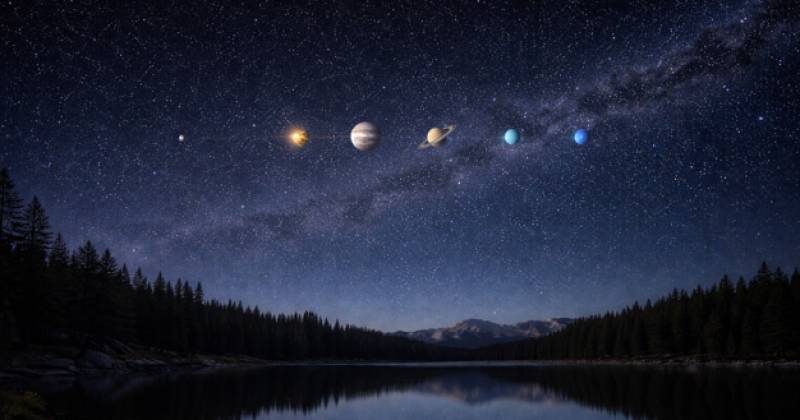
The universe is handing us a rare treat this Friday February 28 when six planets will be visible together in the night sky, forming a sweeping arc from horizon to horizon in what astronomers are calling a truly rare celestial event.
Mercury, Jupiter, Venus, Saturn, Neptune and Uranus will all appear in the same stretch of sky, following the ecliptic, which is the curved path that traces the Sun's journey across the heavens. On a clear night with little light pollution it promises to be quite a sight, so it's worth knowing where to look and what to look for.
Why do they appear in a line?
It's worth clearing something up before we go any further, because the idea of a "planetary alignment" can be a little misleading. The planets aren't actually lined up in space, and there's no physical connection between them.
What you're seeing is a trick of perspective.
Because all the planets orbit the Sun in roughly the same flat plane, when we look out from Earth towards that plane we see them bunched together along the same curve in the sky, a bit like watching runners on a circular track from pitch level.
What you'll be able to see with the naked eye
The good news is that you won't need any special equipment to spot four of the six planets from most parts of Spain. Mercury, Jupiter, Venus and Saturn will all be visible to the naked eye. Venus will be the easiest to find, bright and unmistakable low in the west. Jupiter will be almost as dazzling and is your next best landmark. Saturn has a warm yellowish glow that sets it apart and Mercury will be visible too, although it sits lowest in the sky so you may need a clear, unobstructed horizon to catch it.
When to look and where to look
NASA advises waiting until around an hour after sunset before you start scanning the sky, particularly if you want a chance of seeing Uranus and Neptune. Twilight washes out the fainter planets, so patience pays off here.
In terms of direction, Jupiter will be towards the east or southeast and will be sitting very close to the Moon, making it easy to find. The other planets are best seen by looking west and southwest, with Uranus further round towards the southwest as well.
Do you need a telescope?
For the full experience, yes. Binoculars will help you pick out Uranus, but Neptune is fainter and lower on the horizon and will really need a proper telescope to see well. If you have one available, this is definitely a night to get it out.
How long have you got?
February 28 is the peak date for the alignment, but you won't miss out entirely if conditions aren't perfect that night. The planets will remain broadly visible in this formation into the first few days of March, although exactly what you can see will depend on where you are geographically and how clear the sky is.
Interestingly, this isn't the first time this particular combination has appeared. Almost exactly the same alignment occurred on February 28, 2025, with one notable difference: Mars was also part of the show last year. This time around it has opted out and won't be joining the line-up.
Find a dark spot, give your eyes time to adjust, and enjoy one of those moments that reminds you just how extraordinary the view from our little corner of the solar system can be.