








PROPERTY SEARCH

PROPERTY SEARCH
Key 'rehearsal' day arrives for the much-anticipated solar eclipse in Spain
Stargazers across Spain can test viewing spots now ahead of August 12 total eclipse
People across Spain are already gearing up for one of the most anticipated events of 2026, with a total solar eclipse set to take place on Wednesday August 12. It’s an incredibly rare opportunity, with the next one not expected until 2053, and large parts of the country will be perfectly placed to see it.
Astronomers are now encouraging anyone planning to watch the eclipse to take advantage of a simple check on Thursday April 30. The position of the sun in the sky on this date will closely match where it will sit during the eclipse in August, giving people a chance to test whether their chosen viewing spot offers a clear line of sight.
According to the National Astronomical Observatory, this is one of the easiest ways to avoid disappointment on the day itself.
Mario Tafalla explained that “the sun will give us the opportunity these next few days to know where it will be on August 12,” meaning any obstacles such as buildings, trees or hills can be spotted in advance.
Timing plays an important role in this check. Rather than heading out at the exact time the eclipse will peak in August, experts recommend looking at the sun around seven minutes earlier than the expected time for your location. This slight adjustment accounts for the difference between solar time and official clock time, which can affect positioning.
The key thing to look for is whether the sun is clearly visible low in the sky towards the west. If it can be seen between around 8.20pm and 8.26pm on Thursday, then conditions should be suitable for watching the eclipse in August from that same spot.
The path of totality, where the moon will completely cover the sun, will stretch across a large part of Spain. Regions including Galicia, Asturias, Castilla y León, Madrid, Castilla-La Mancha, Cantabria, La Rioja, the Basque Country, Navarra, Aragon, Catalonia, Valencia and the Balearic Islands are all expected to experience the full effect.
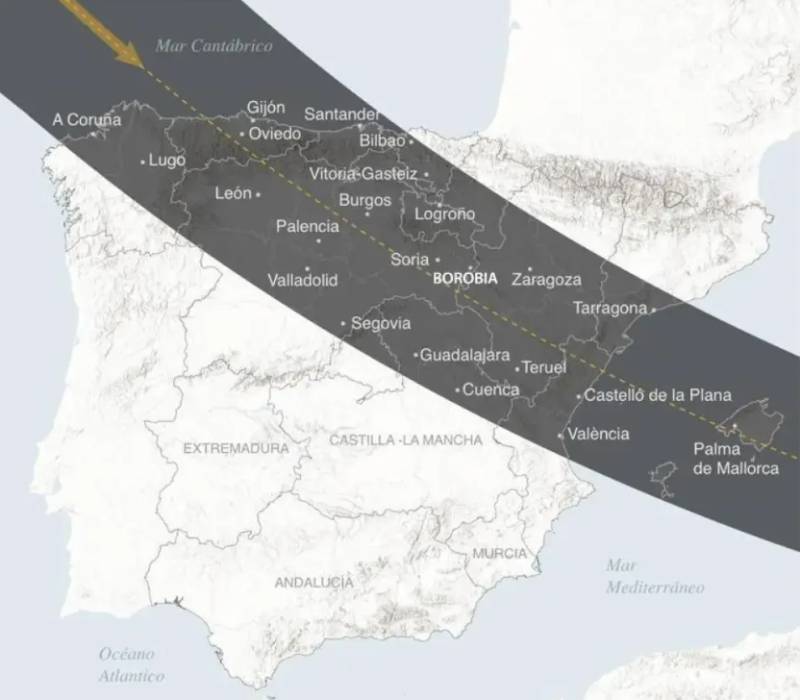
Outside this band, the eclipse will still be visible but only partially, with the event lasting longer but without the dramatic moment of total darkness.
Even in the best locations, totality will be relatively short. In most cities it will last between one and two minutes, with shorter durations closer to the edges of the path. Places such as A Coruña, Palma, Valladolid, León, Bilbao, Tarragona, Zaragoza, Santander, Segovia, Soria and Valencia are all expected to offer good viewing conditions.
One standout location is Oviedo, where the total phase could last close to one minute and 48 seconds, making it one of the longest viewing times in the country.
With the eclipse taking place at the height of summer, there is also a good chance of clear skies across much of Spain, although visibility will ultimately depend on local conditions on the day.
Images: Freepik / Borobia Astronomical Observatory