





Cartagena beaches: Playas de Calblanque
The Calblanque beaches are within a protected regional park
The municipality of Cartagena is home to a series of beaches on the Mediterranean coastline which fall within the protected natural park of the Parque Regional de Calblanque, Monte de las Cenizas y Peña del Águila.
Click for details of the 2020 4:40 bus service to the Calblanque beaches
The 1,882 hectares of Calblanque have been a protected nature reserve since 1987 in recognition of the fact that the area is one of the most typical of the coastline of the Region of Murcia in its natural state. There are cliffs, sandy beaches, fossil dunes, salt flats, saltwater marshes, mountainous outcrops and crops, all of which are now protected against the relentless onslaught of development. The pressure from human civilization is especially noticeable in the summer, when litter and road traffic exacerbate the vulnerability of this area to damage by human hands, and for this reason motor vehicle access is now restricted every year.
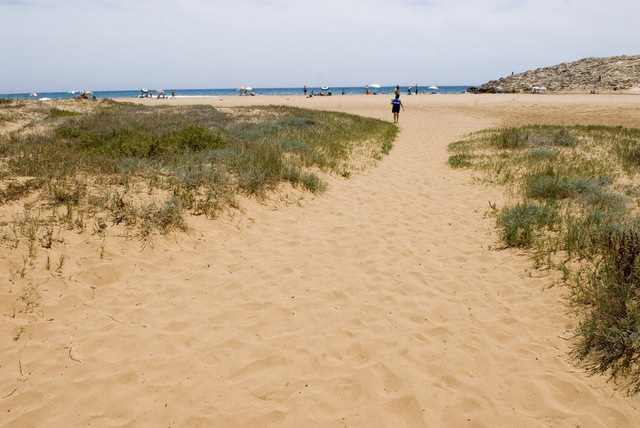
The richness of the flora in the area includes dwarf palms, juniper and other bushes. These are especially prevalent in the mountains, which include the Cabezo de la Fuente (342 metres) and the Cabezo del Horno (258 metres). The lower ground associated with farming features fig and carob trees as well as some species which are indigenous to the south-east of the Iberian peninsula, such as Euphorbia mazarronensis and Guiraoa arvensis, both of which are under threat of extinction.
The flora is also of great interest in the Rasall salt flats and the saltwater marsh around them, containing species which have adapted to life in a salty environment. These include sempervivums and tamarix, and living among them are sea birds such as stilts, flamingos, sea herons and other waders. Under the water the Spanish toothcarp (fartet), another endangered species, can also be found.
In the dunes there are bird species such as the stone-curlew, the lesser short-toed lark and the crested lark as well as the red-tailed spiny-footed lizard, while in the mountains there are eagle owls, bee-eaters, Bonelli’s eagles and warblers. Mammals are represented by foxes, rabbits, badgers and beech martens.
The park also has several fine, sandy, wild beaches, which are very popular with those who just want to get away from it all and enjoy a beautiful beach undisturbed by beach bars and pedaloe hire.
Contrary to what is apparently popular belief, these are NOT nudist beaches (officially) although it is not infrequent to come across a fellow bather wearing less than might be considered customary in public places.
This area can be accessed in several ways, with different entrances to the various beaches and a vast open area which can be largely explored on foot.
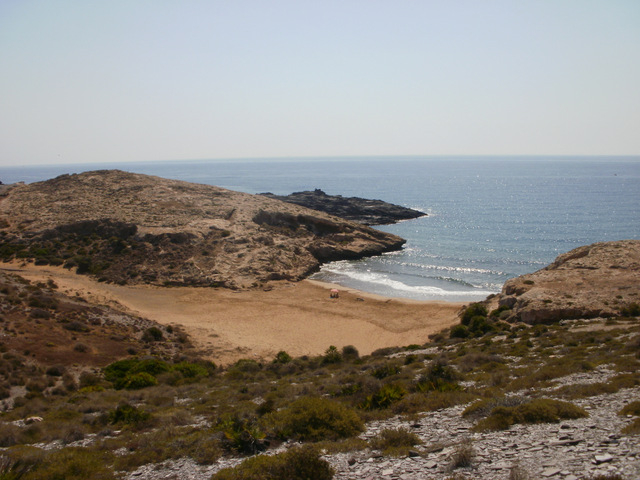
Cobaticas information centre
There is an information centre at Las Cobaticas which is open to the general public .
The easiest access is on the opposite side of the road to the La Manga Go Karting, at Km13 on the RM12, which leads down to a small bay from which it is easy to set off on foot and follow the coast path. Strong footwear is recommended as the route is on loose stone, with strong gradients.
Opening Times:
Visitor Centre opening times:
Open Tuesday to Sunday including festival days:
From October to May from 9am to 2pm and 3pm to 5.30pm
June, July, August and September from 8.30am to 3.30pm
Telephone: 649 22 75 82
Email: infocalblanque@carm.es
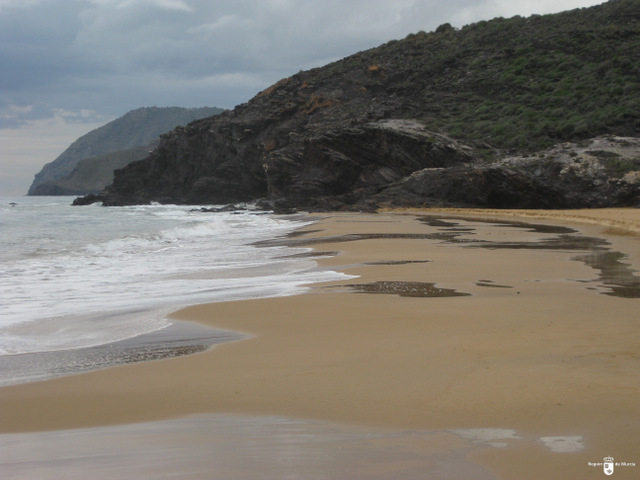
Calblanque beaches
The Calblanque beaches stretch out along the coastline, fringed with dunes, and rocky bays, with naturally golden sand. They’re undeveloped and of course this also renders access more difficult, so these are not suitable for those with disabilities or mobility issues.
The coves and beaches along this coastline are:
Playa de Calblanque (300 metres long by 30 metres wide, fine golden sand)
Cala Arturo
Cala Magre
Playa Dentoles
Playa Larga
Playa Las Cañas
Playa Negrete
Playa Parreño
During the peak summer weeks there is lifeguard cover between 11.00 and 20.00 on the main Calblanque beach, but nothing on the more inaccessible beaches which can be accessed on foot or by boat.
During the peak summer weeks, access is restricted to the Calblanque beach, and only limited numbers of vehicles are allowed within the park.
There are steep fines for parking in non-authorised locations within the park.
Access to the beaches
Approaching Calblanque via the Autopista A-7 Alicante-Cartagena, take exit 800, which leads to Mar Menor, la Manga-Cabo de Palos. A sign for the MU-312, signposted for Calblanque is located after the exit.
Click for further local information about Cartagena, or for an overview of the beaches of Cartagena.