









PROPERTY SEARCH

PROPERTY SEARCH
Asteroid set to smash into the Moon in biggest impact humanity has ever witnessed
The December 2032 collision will release a force greater than any nuclear explosion on Earth
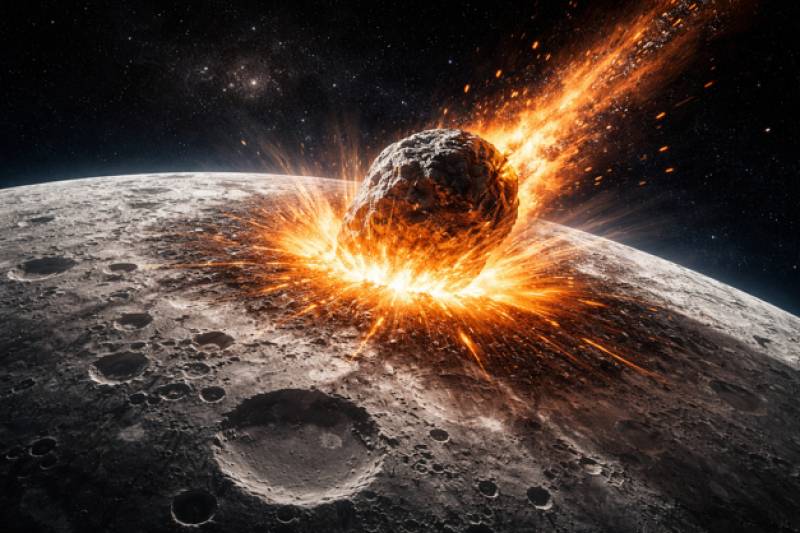
Mark your calendars for a once-in-a-lifetime event on December 22, 2032. That's the day a massive asteroid is expected to slam into the Moon in what scientists are calling the most violent cosmic event humanity has ever seen.
Asteroid 2024 YR4, roughly the size of a 15-storey building, will hurtle towards the lunar surface at a staggering 48,000 km/h after more than eight years of anxious monitoring since its discovery. The impact will release energy equivalent to 8 megatons, a force greater than any nuclear explosion ever recorded.
Andrew Rivkin, a researcher at Johns Hopkins University, has been emphatic about the scale of what's coming.
"It is the greatest impact ever witnessed by humankind," he said, underlining just how exceptional this event will be.
When 2024 YR4 was first detected in late 2024, there were fears it might be heading for Earth. Thankfully, scientists quickly determined the Moon would take the hit instead. Since then, observatories and space agencies around the world, including NASA, have been tracking its every move.
The James Webb Space Telescope has played a crucial role in refining our understanding of the asteroid's trajectory. The asteroid itself measures around 60 metres in diameter and will leave a permanent scar on the Moon's surface in the form of a new crater that will be visible for generations to come.
Estimates suggest that an impact of this magnitude hasn't occurred on the Moon for at least 5,000 years. This means we'll have front-row seats to witness a phenomenon not seen in millennia, armed with technology capable of measuring every phase of the collision. Scientists will gain invaluable insights into how energy disperses during high-power impacts and how the lunar regolith behaves under extreme forces.
If the collision happens as predicted, observers on Earth should be able to see an optical flash with ground-based telescopes, followed by an infrared emission that could last for hours. It's a unique opportunity to study the physics of impacts in real time.
What’s a little worrying is that models suggest the force of the collision could eject up to 100 million kilos of lunar material into space. Some of those fragments might be pulled towards Earth by gravity, creating an artificial meteor shower that will light up our skies weeks after the impact.
While that part sounds spectacular, there's a definite downside. The cloud of debris could temporarily increase the risk to satellites and orbital stations, so space agencies are already studying preventative measures to protect vital communication and navigation infrastructure.
For now, the scientific community is watching and waiting. December 2032 might seem far away, but when it arrives, humanity will witness something truly extraordinary.